Cash Book vs Petty Cash: How Small Businesses Keep Them
Every business that handles cash needs two simple records: a cash book for all money in and out, and a petty cash book for small office spends. Both are easy to keep and save a lot of trouble at month end.
What is a cash book?
A cash book records every receipt and payment in date order, with the balance after each entry. Many businesses keep two columns, one for cash and one for bank, so they know at any moment how much is in the drawer and how much is in the account. UPI and card receipts go into the bank column because the money reaches your bank.
A good line in a cash book has: date, details, voucher or bill number, whether it is a receipt or payment, the mode (cash, bank, UPI), a category (sales, rent, purchase, salary) and the amount.
What is a petty cash book?
Petty cash is a small fixed amount, say ₹2,000 or ₹3,000, kept in a separate box for small spends: courier, tea, stationery, auto fare. Each spend is written with the date, purpose, amount and who spent it. When the box runs low, it is topped up back to the fixed amount from the main cash. This is called the imprest system.
Why keep them separate?
- The main cash book stays clean, without fifty small lines of ₹40 and ₹60.
- One person can handle petty cash without access to the main cash.
- You can see at a glance how much small spending costs you each month.
Daily habits that stop cash going missing
1. Write it the same day. Memory at the end of the month is never complete.
2. Count the drawer at closing and compare with the cash balance in the book. Find any difference that day.
3. Give every entry a voucher number and keep the bill or slip with it.
4. Never mix personal and business cash. If you take money home, write it as owner drawings.
5. Deposit surplus cash in the bank and record it as a transfer from cash to bank.
Common mistakes
- Recording UPI receipts as cash, so the cash balance never matches.
- Forgetting cash deposits, which makes cash look higher and bank lower.
- No category, so at year end nobody knows how much went on transport or repairs.
A ready format
Our Cash Book, Day Book & Petty Cash Register keeps running cash and bank balances on every row, a petty cash register with the float left, and a monthly summary by category with a chart. It works in Excel and Google Sheets.
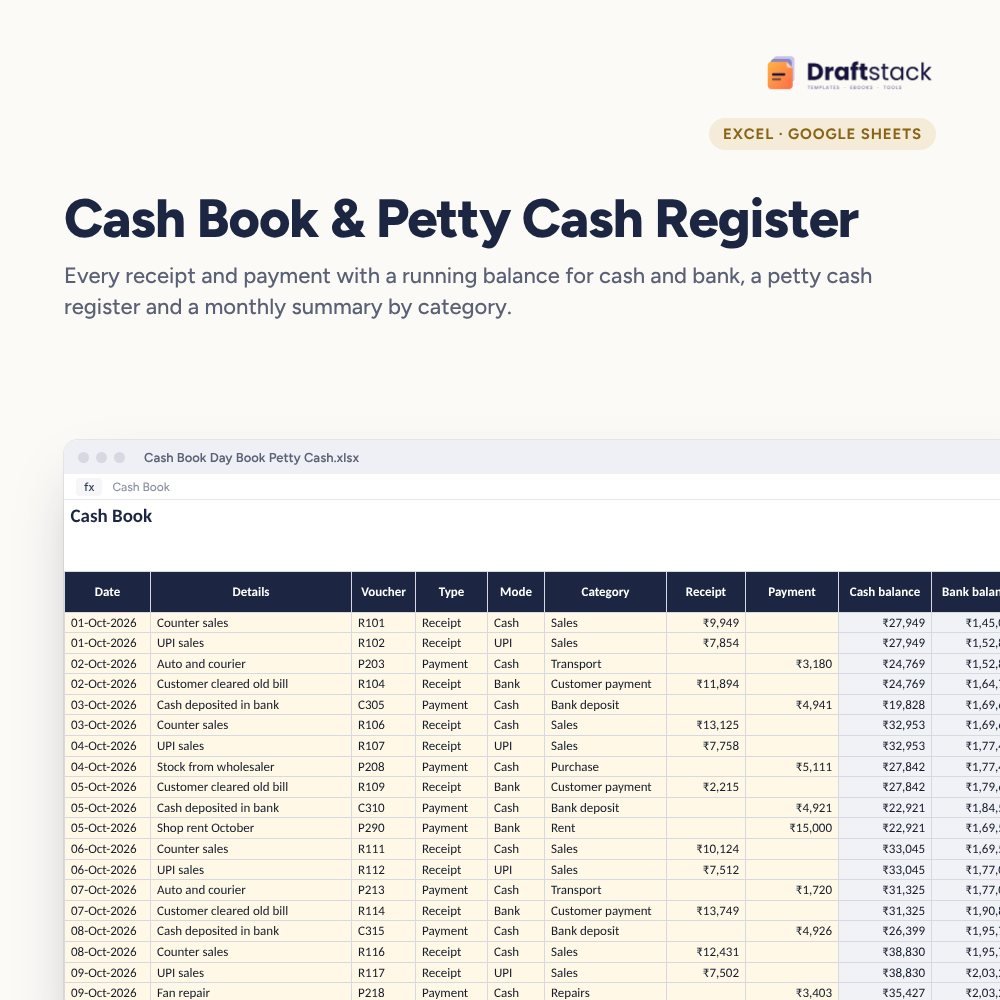 The template from this guideCash Book, Day Book & Petty Cash Register (Excel)
₹112
 WhatsApp
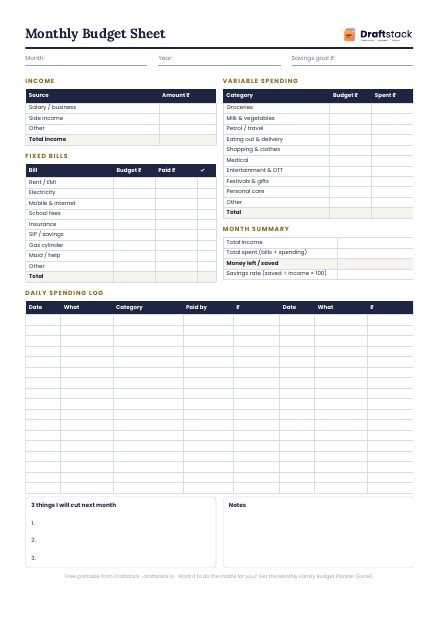
Free Monthly Budget Sheet
A printable one-page budget sheet: income, fixed bills, daily spending and savings for the month. Print it or fill it on your phone.
More guides
How to Make a Project Report for a Mudra or PMEGP Loan
What a bank wants in a project report for a Mudra or PMEGP loan, how to estimate project cost and sales, and how DSCR decides if the loan is approved.
Share Market Basics: Demat, NSE, BSE and Index Explained
A plain-language guide to how the Indian share market works: shares, exchanges, SEBI, Nifty and Sensex, demat accounts and how an order is placed.
Get Your Shop on Google Maps: Google Business Profile Step by Step
How to add your shop or clinic to Google Maps with a Google Business Profile, get verified, add photos and reviews, and show up in near me searches.