How to Make a Project Report for a Mudra or PMEGP Loan
A project report is the document that explains your business plan in numbers: what you will spend, where the money comes from, how much you will earn and how you will repay the loan. A clear report gets faster answers from the bank.
What goes in a project report
1. About the business: name, owner, address, activity, experience of the promoter.
2. Project cost: machinery, furniture, interiors, computer, pre-operative expenses and working capital. Attach quotations for big items.
3. Means of finance: your own contribution and the loan amount.
4. Projected profit and loss for 3 to 5 years: sales, raw material, wages, rent, power, other expenses, depreciation, interest, tax and net profit.
5. Repayment schedule: principal and interest for each year.
6. Ratios: DSCR and break-even point.
Estimating sales honestly
Start from capacity and real demand. A bakery that can sell 120 kg of products a day at an average of ₹200 per kg and works 25 days a month earns about ₹6 lakh a month at full capacity. In year 1, assume 60 to 70 percent of that. Growth of 8 to 12 percent a year is believable; 50 percent is not, and it makes the officer doubt the rest of the report.
Own contribution
Banks expect the owner to put in part of the project cost. Many schemes and banks look for around 10 to 25 percent. Mudra and PMEGP have their own rules for categories and subsidy, which change from time to time, so confirm current limits with the bank or the official scheme website.
DSCR: the number that decides
DSCR = (net profit + depreciation + interest) ÷ (principal repaid + interest) for each year. It shows how many times your cash covers the loan payments. Most banks want an average DSCR of about 1.5. If yours is below 1.25:
- increase your own contribution,
- ask for a longer tenure,
- cut project cost that does not add sales,
- or recheck costs that look too high.
Break-even
Break-even sales are the sales at which you make neither profit nor loss. Fixed costs (wages, rent, power, other expenses, depreciation, interest) divided by the contribution margin (1 minus raw material percentage) gives the figure. A business that breaks even at 50 to 60 percent of projected sales has a good safety margin.
Mistakes that delay loans
- No quotations for machinery.
- Working capital missing from the project cost.
- Sales that jump without reason.
- DSCR not shown, or calculated wrongly.
- Different figures in the report and the application form.
Make it in an evening
Our Project Report for Bank Loan workbook builds the whole report from a single settings sheet and your project item list: project cost, means of finance, 5-year projections, repayment schedule, DSCR and break-even, printed on A4.
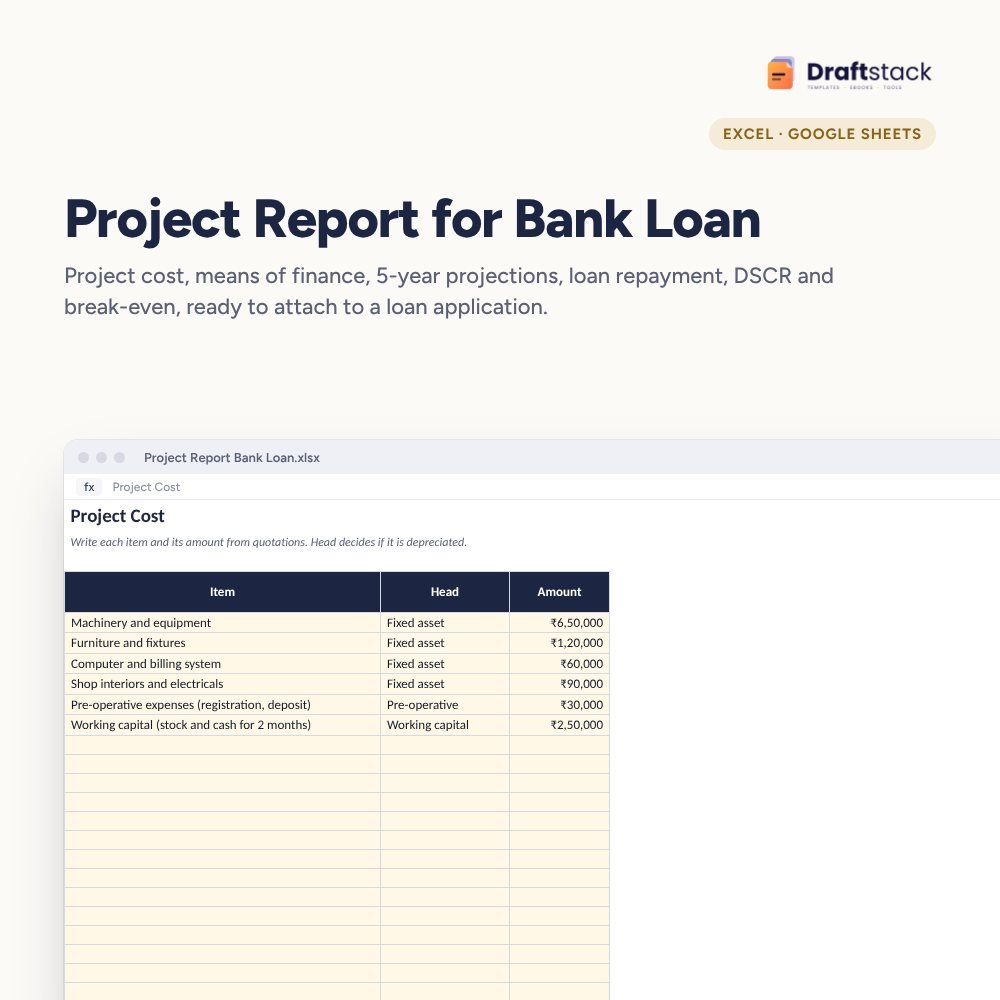 The template from this guideProject Report for Bank Loan: Mudra & PMEGP (Excel)
₹262
 WhatsApp
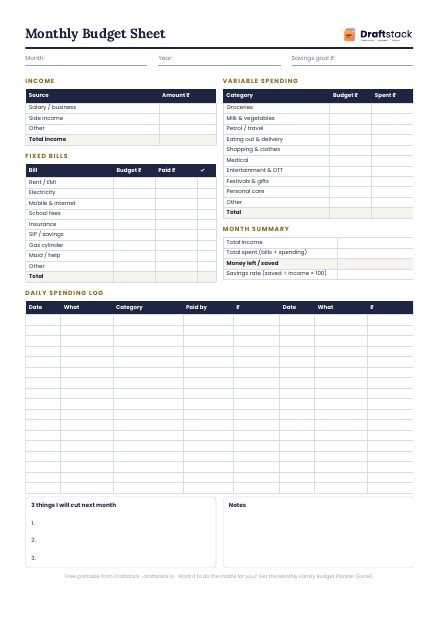
Free Monthly Budget Sheet
A printable one-page budget sheet: income, fixed bills, daily spending and savings for the month. Print it or fill it on your phone.
More guides
Share Market Basics: Demat, NSE, BSE and Index Explained
A plain-language guide to how the Indian share market works: shares, exchanges, SEBI, Nifty and Sensex, demat accounts and how an order is placed.
Get Your Shop on Google Maps: Google Business Profile Step by Step
How to add your shop or clinic to Google Maps with a Google Business Profile, get verified, add photos and reviews, and show up in near me searches.
How to Increase Typing Speed for SSC and Court Exams
A practical method to type faster and with fewer mistakes for government typing tests, with a daily routine, speed targets and how WPM is worked out.