How to Calculate Salary from Attendance (with Overtime)
Salary from attendance is simple once you fix three things: how many days you divide the monthly salary by, which days are paid, and the overtime rate. Write these into your policy so every month is calculated the same way.
The basic formula
Earned salary = monthly salary ÷ divisor days × payable days
- Divisor days: many companies use the actual days in the month (28 to 31). Others use a fixed 30 or 26. Pick one and use it every month.
- Payable days: present days + paid leave + weekly offs + paid holidays.
Example: monthly salary ₹18,000, October has 31 days, the employee was absent 2 days. Payable days = 29. Earned salary = 18,000 ÷ 31 × 29 = ₹16,839.
Half days and late marks
A half day usually counts as 0.5 present and 0.5 absent. Some companies convert three late marks into a half day; if you do, write it in the policy and mark HD on the third late day.
Weekly offs and holidays
Weekly offs and declared holidays are normally paid. If an employee is absent on the days just before and after a holiday, some policies treat the holiday as unpaid too; follow your written policy and state rules.
Overtime pay
Overtime is work beyond normal hours. Under the Factories Act, overtime is paid at twice the ordinary rate of wages. Shops and establishments follow state rules, which are often similar.
Hourly rate = monthly salary ÷ divisor days ÷ working hours per day
OT pay = hourly rate × OT rate × OT hours
Example: ₹18,000 ÷ 31 ÷ 8 = ₹72.58 per hour. 10 OT hours at 2× = 72.58 × 2 × 10 = ₹1,452.
Gross pay and deductions
Gross pay = earned salary + OT pay (+ any allowances). Deductions such as PF (employee 12% of basic), ESI where applicable and professional tax come after this and depend on your salary structure.
Mistakes to avoid
- Using 26 days one month and 31 the next.
- Not recording OT hours daily, then guessing at month end.
- Paying for absent days because attendance was not marked.
- Keeping attendance on loose paper that gets lost before salary day.
Keep records for inspections
Labour inspectors and auditors can ask for attendance and wage registers. Keep the monthly register, the overtime record and the salary paid for each employee for the years your state rules require, signed or approved by the person in charge.
A ready register
Our Employee Attendance, Overtime & Salary Register has 31 daily drop-downs and works out present days, earned salary, OT pay and gross pay for every employee, with a department summary.
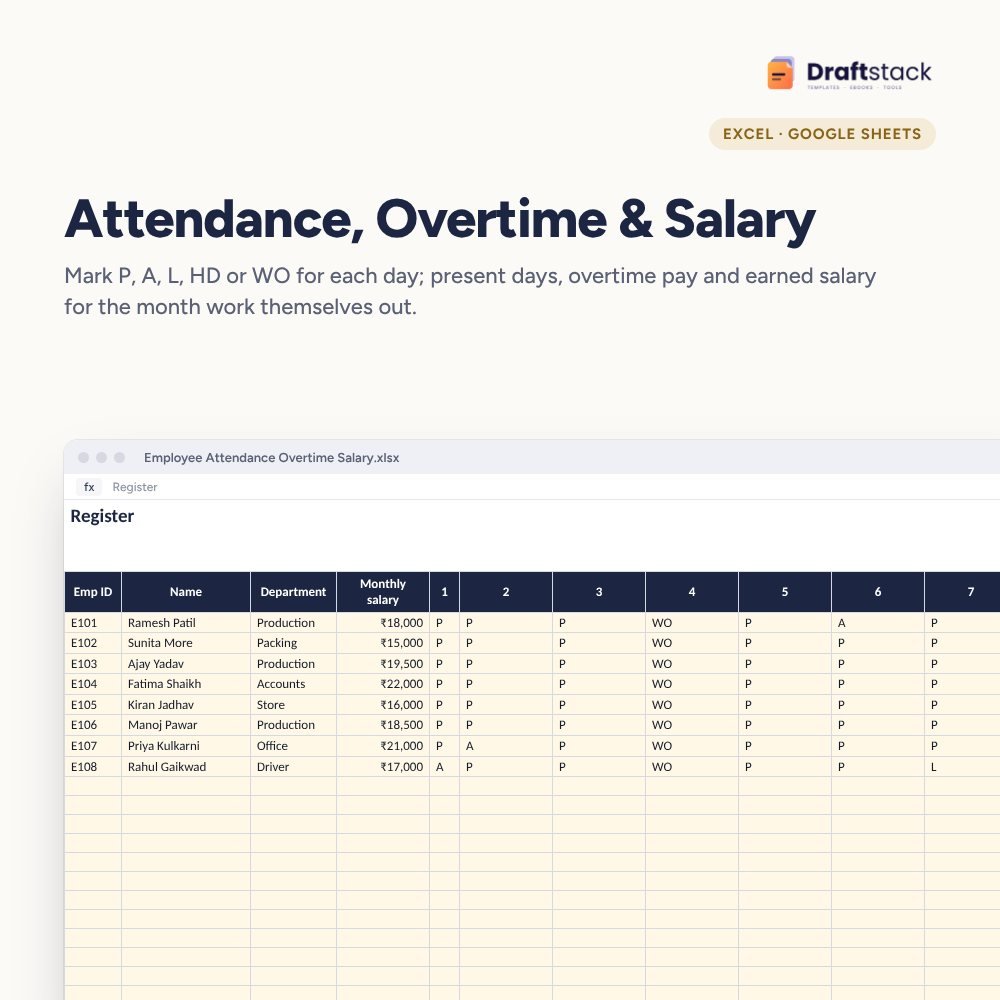 The template from this guideEmployee Attendance, Overtime & Salary Register (Excel)
₹149
 WhatsApp
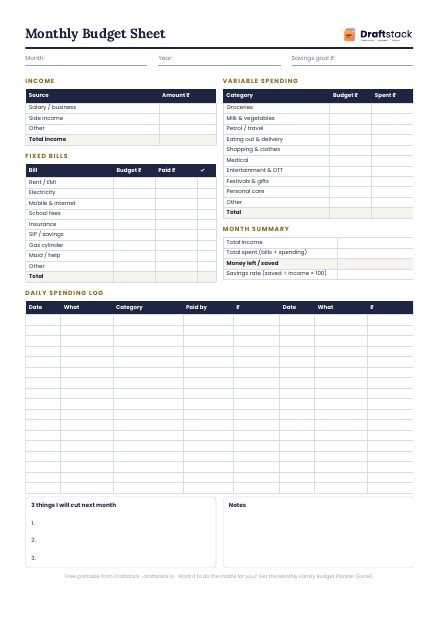
Free Monthly Budget Sheet
A printable one-page budget sheet: income, fixed bills, daily spending and savings for the month. Print it or fill it on your phone.
More guides
Bank Reconciliation Statement: Steps with an Example
Why the cash book and bank statement do not match, the four common reasons, and how to prepare a bank reconciliation statement step by step with a worked example.
How to Read a Balance Sheet: A Shop Owner's Guide
What each line of a balance sheet and profit and loss account means for a small business, and five quick checks that show if the business is healthy.
Cash Book vs Petty Cash: How Small Businesses Keep Them
What a cash book and a petty cash book are, how to write them every day, and the simple habits that stop cash going missing in a small business.