How to File ITR-1 Online Yourself: Step-by-Step
If your income is mainly salary or pension, with some bank interest, you can file your income tax return yourself in about 30 minutes. The form for most salaried people is ITR-1 (Sahaj), and the portal fills most of it for you.
Can you use ITR-1?
You can use ITR-1 if you are a resident individual with total income up to ₹50 lakh from:
- Salary or pension
- House property (within the limit shown on the form)
- Other sources: savings and FD interest, family pension, dividends
- Agricultural income up to ₹5,000
- Long-term capital gains on listed shares and equity mutual funds up to ₹1.25 lakh (the form now allows this)
You cannot use ITR-1 if you are a company director, hold unlisted shares, have foreign assets or income, have business income, have other capital gains, or want to carry forward losses. These need ITR-2, ITR-3 or ITR-4.
Keep these ready
- PAN and Aadhaar (linked; see our PAN-Aadhaar linking guide)
- Form 16 from your employer (from tax year 2026-27 it is called Form 130)
- AIS and Form 26AS from the portal, to check TDS and interest
- Bank interest certificates for savings and FDs
- Rent receipts, investment proofs and health insurance receipts, if you choose the old regime
- A bank account that is pre-validated on the portal for your refund
Step-by-step on the portal
1. Log in at incometax.gov.in with your PAN (user ID) and password, or Aadhaar OTP.
2. Go to e-File → Income Tax Returns → File Income Tax Return.
3. Choose the assessment year (for income earned April 2025 to March 2026, it is AY 2026-27) and Online mode.
4. Choose Individual, then ITR-1.
5. Pick the reason for filing (for example, taxable income above the basic exemption).
6. Personal information: check your name, address, bank account and choose the tax regime.
7. Gross total income: the portal pre-fills salary from your employer's TDS data. Compare each line with Form 16. Add exempt allowances only if you use the old regime.
8. Other sources: the pre-filled interest is often incomplete. Add savings interest and FD interest from your bank certificates and AIS. Missing interest is the top reason for notices.
9. Deductions (old regime): enter investments, health insurance and others with the details asked.
10. Taxes paid: check that the TDS matches Form 26AS.
11. Tax computation: if tax is payable, pay it through e-Pay Tax and add the challan. If a refund is due, check the amount.
12. Preview, validate and submit.
Verify the return, or it does not count
After submitting, you must e-verify within 30 days:
- Aadhaar OTP (easiest)
- Net banking
- Bank or demat account EVC
- Or send the signed ITR-V by post to the CPC in Bengaluru
A return that is not verified is treated as not filed.
Late or wrong return?
- Missed the 31 July deadline (for salaried people)? You can still file a belated return until 31 December of the assessment year. For income of 2025-26, that is 31 December 2026. A late fee applies: ₹5,000, or ₹1,000 if total income is up to ₹5 lakh. Interest applies on unpaid tax.
- Made a mistake? File a revised return from the same menu before the last date for revisions shown on the portal.
Common mistakes to avoid
- Not adding savings and FD interest
- Choosing the wrong regime by mistake
- Claiming deductions in the new regime that it does not allow
- Leaving out salary from a previous employer in the same year
- Forgetting to e-verify
Do it with confidence next time
Keep a simple folder for the year with Form 16, interest certificates and proofs. Our ITR & Income Tax Organizer has a checklist and an Excel sheet for every number the return asks, and the File Your ITR Yourself ebook walks through every screen with screenshots. Before choosing the regime, compare both with the free tax regime calculator.
This guide is general information, not tax advice.
Frequently asked questions
What is the last date to file ITR-1?
For salaried people and pensioners without audit, the usual due date is 31 July after the year ends. A belated return can be filed until 31 December of the assessment year with a late fee.
Is it compulsory to file ITR if my income is below ₹12 lakh?
If your income is above the basic exemption limit (₹4 lakh in the new regime), you should file, even if the rebate makes your tax nil. Filing is also needed to claim a TDS refund.
Do I need to attach Form 16 to the return?
No. Nothing is attached. Keep Form 16 and proofs safely in case the department asks.
How do I know my return has been processed?
You get an email and SMS with an intimation after processing. You can also check under View Filed Returns.
Can I file ITR-1 on my phone?
Yes. The portal works on a phone browser, and the official AIS and e-filing apps help with checking data. A laptop is easier for the forms.
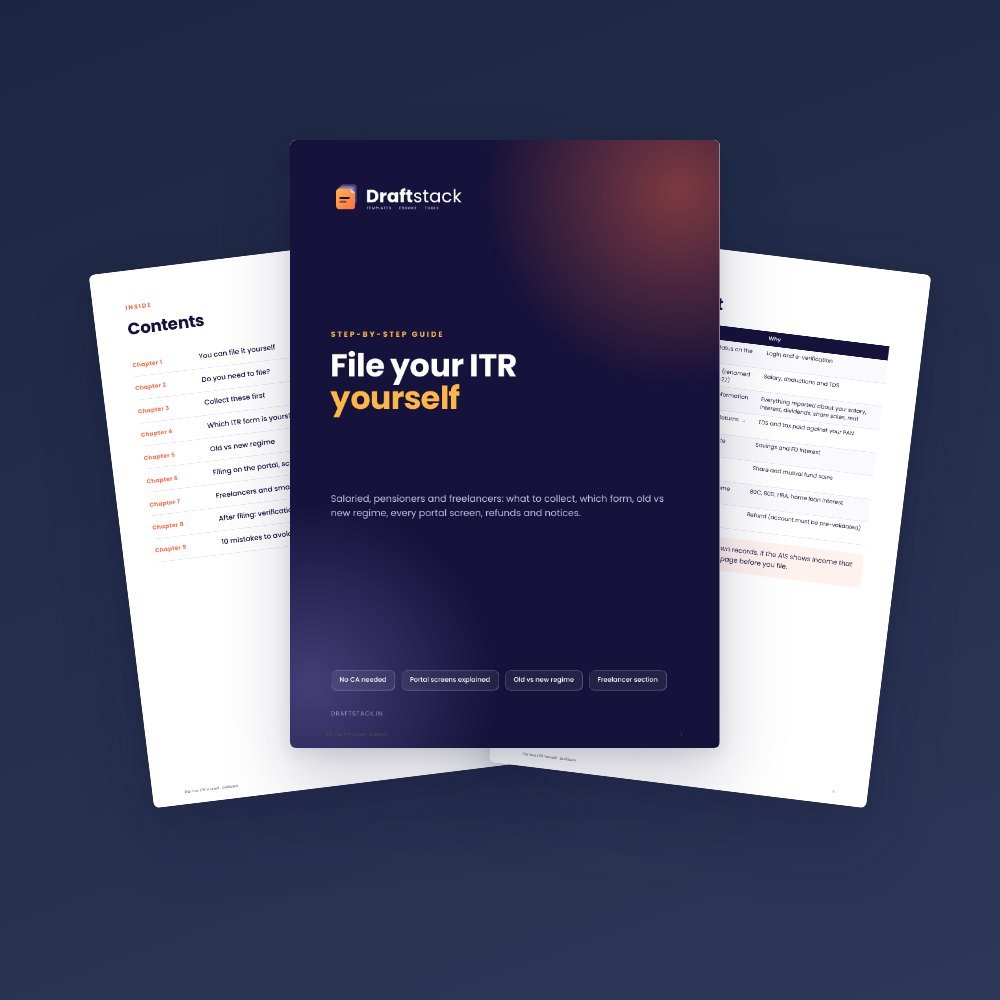 The template from this guideFile Your ITR Yourself: Step-by-Step Guide for Salaried, Pensioners & Freelancers (Ebook)
₹112
 WhatsApp
Free Monthly Budget Sheet
A printable one-page budget sheet: income, fixed bills, daily spending and savings for the month. Print it or fill it on your phone.
More guides
CIBIL Score: How to Check It Free and Improve It
What a good CIBIL score is, how to check it free, what pulls it down, the 2026 reporting changes, and a 90-day plan to improve your score and fix errors.
Income Tax Refund Status: How to Check and Why It's Delayed
How to check your income tax refund status on the e-filing portal, why refunds get stuck, how to fix bank account and PAN problems, and how to request a reissue.
AIS and Form 26AS: How to Check and Fix Mismatches
What AIS, TIS and Form 26AS (now Form 168) show, how to download them, how to give feedback on wrong entries and how to avoid a tax notice for mismatch.