How to Never Miss a Credit Card Due Date (and Avoid Interest)
Credit cards are cheap money if you pay in full and on time, and very expensive money if you don't. Most people who pay interest are not careless; they simply lose track of dates across two or three cards.
Statement date and due date are not the same
- The statement date (or billing date) is when the bank closes the month's spends and generates your bill.
- The due date is usually 15 to 20 days later. It is the last day to pay without a late fee.
- Spends made just after the statement date get the longest interest-free period, up to about 50 days.
Why "minimum due" is a trap
The minimum due is usually 5% of the bill. Paying it avoids the late fee, but the bank then charges interest, often 3 to 3.75% a month (over 40% a year), on the whole balance from the date of each purchase. You also lose the interest-free period on new spends until the balance is cleared. Pay the total amount due whenever you can.
What happens if you pay late
1. A late payment fee, which rises with the bill amount (commonly ₹500 to ₹1,300)
2. Interest on the full balance
3. If the payment is more than 30 days late, it is reported to credit bureaus and your score drops
Credit use and your score
Credit use is your unpaid balance divided by your limit. Above 30% starts to pull your score down, even when you pay on time, because it looks like you depend on credit. If one card is often near its limit, spread spends across cards or ask for a higher limit.
A 10-minute monthly routine
1. When each statement email arrives, write down the total due, minimum due and due date.
2. Set a phone reminder three days before the due date.
3. Pay the total due by UPI or net banking and note the date.
4. Once a month, check each card's credit use and how much you've spent towards the annual fee waiver.
5. If a card's fee is not worth its rewards, ask the bank to waive it or move to a lifetime-free card.
Auto-pay helps, with one caution
Setting up auto-debit for the total amount due is the simplest way to never be late. Make sure the linked account always has enough balance; a failed auto-debit counts as a missed payment.
Our Credit Card Bill & Due Date Tracker keeps all your cards on one page: due dates counting down, unpaid amounts, credit use per card and fee waiver progress. No card numbers needed.
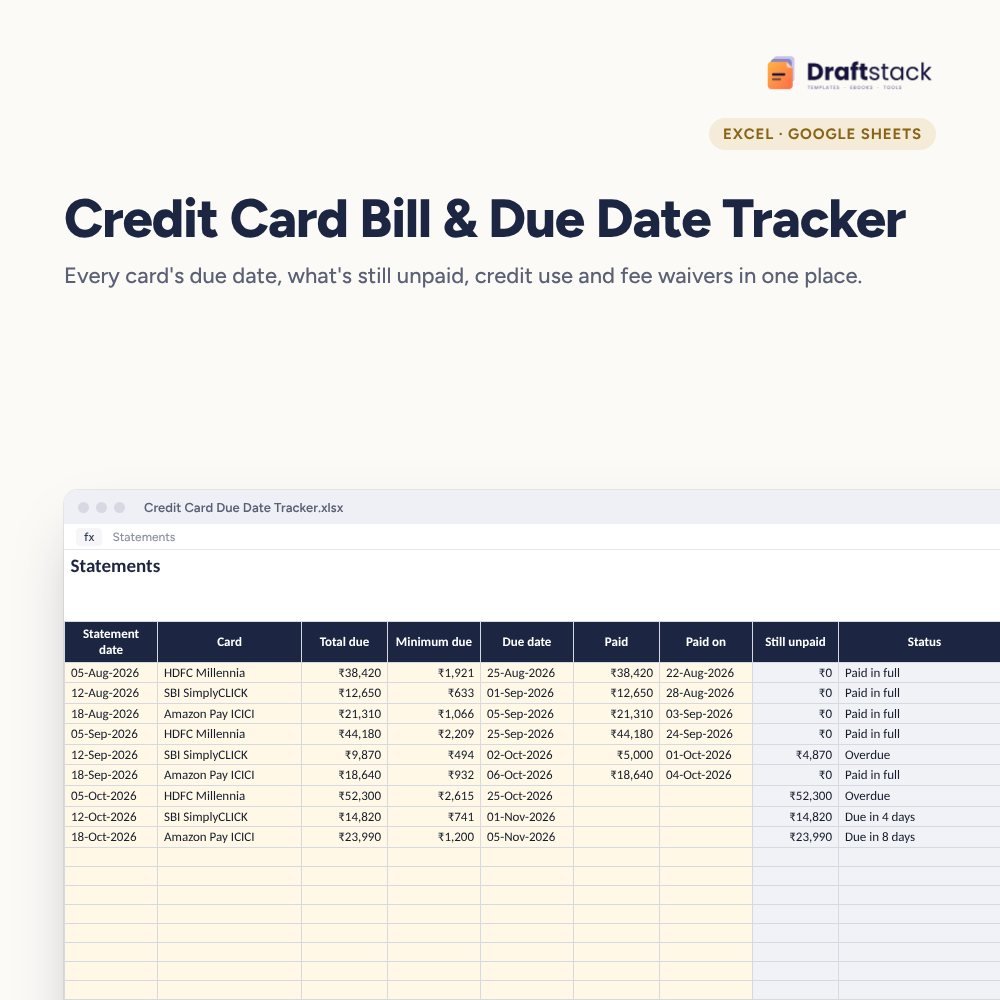 The template from this guideCredit Card Bill & Due Date Tracker (Excel)
₹149
 WhatsApp
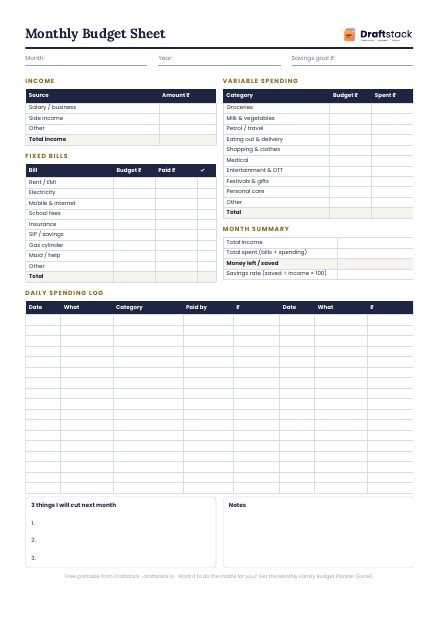
Free Monthly Budget Sheet
A printable one-page budget sheet: income, fixed bills, daily spending and savings for the month. Print it or fill it on your phone.
More guides
How to Keep a Record of Your Family's Gold Jewellery
What to note for each piece, how to value 22K and 18K gold from today's rate, why HUID and bills matter, and how jewellery schemes really work.
How to Calculate Your Electricity Bill from Units
Read your meter, work out units, apply slab rates the way boards do, and check every line on your bill. With a worked example.
Monthly Ration List for a Family of 4 (with Budget)
How much atta, rice, dal and oil a family of four really uses in a month, what it costs in 2026, and how to cut the bill without eating less.