Depreciation as per Companies Act and Income-tax: A Simple Guide
Indian companies work out depreciation twice: once under the Companies Act for their financial statements, and once under income-tax rules for their tax return. The two rarely match, and that's normal.
Companies Act: useful life and residual value
Schedule II gives indicative useful lives for asset classes, for example:
- Computers and laptops: 3 years; servers and networks: 6 years
- Office equipment: 5 years; furniture: 10 years
- General plant and machinery: 15 years; motor cars: 8 years
- Factory buildings: 30 years
Residual value is usually taken at up to 5% of cost. Companies can use different lives with technical justification.
SLM or WDV
- Straight line (SLM): the same amount every year. Yearly depreciation = (cost − residual) ÷ useful life. A ₹24.5 lakh machine with 15 years and 5% residual: (24.5 − 1.225) ÷ 15 ≈ ₹1.55 lakh a year.
- Written down value (WDV): a fixed rate on the reducing balance. Rate = 1 − (residual ÷ cost)^(1 ÷ life). For 10 years and 5% residual, the rate is about 25.9%.
Charge only for days used
An asset put to use on 12 May is used for 324 days in a year ending 31 March, so it gets 324/365 of a full year's depreciation. Sold assets stop depreciating on the sale date.
Income-tax: blocks of assets
Tax depreciation is worked out on blocks: all assets with the same rate form one block. Common rates:
- Plant and machinery 15%, computers 40%, furniture 10%, buildings 10%, motor cars 15%, intangibles 25%
Depreciation = (opening WDV + additions − sale proceeds) × rate.
The 180-day rule
If an asset is put to use for less than 180 days in the year of purchase, only half the rate applies that year. A server bought on 2 November gets 20% instead of 40% in that year. The rest continues in later years through the block.
Keep a proper register
For each asset: ID, description, class, date put to use, cost, location, method and any sale. Physically verify assets once a year and tag them; auditors often ask for it.
Why the numbers differ
Different lives, rates and methods mean book profit and taxable profit differ. The difference creates deferred tax in your accounts, which your auditor works out.
Our Fixed Asset Register with Depreciation works out Companies Act depreciation by days used (SLM or WDV) and income-tax depreciation by block with the 180-day rule, and rolls forward when you change the year.
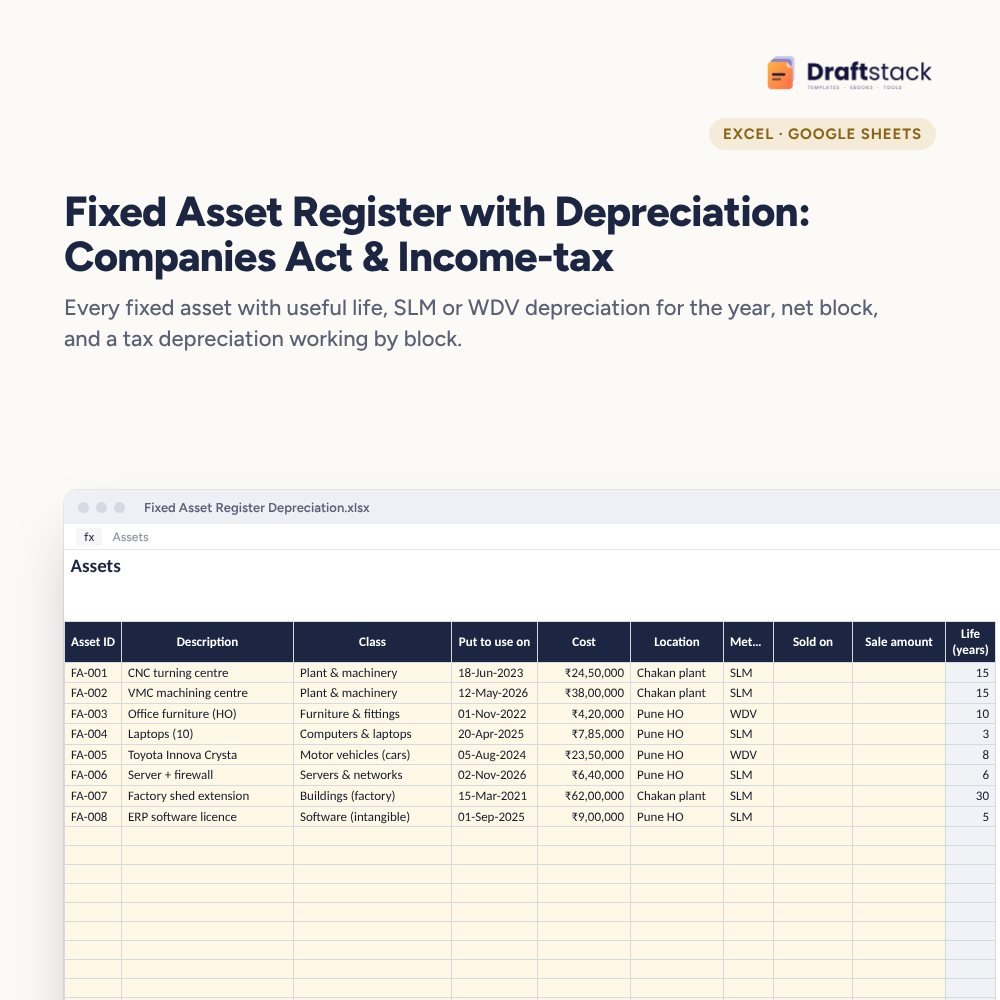 The template from this guideFixed Asset Register with Depreciation: Companies Act & Income-tax (Excel)
₹399
 WhatsApp
Free Monthly Budget Sheet
A printable one-page budget sheet: income, fixed bills, daily spending and savings for the month. Print it or fill it on your phone.
More guides
How to Calculate Earned Leave and Leave Encashment
Earned, casual and sick leave explained, accrual and carry-forward, how to count leave days around weekends and holidays, and how encashment is worked out.
How to Track Candidates Without an ATS
Set up positions and stages, move candidates quickly, measure time to fill and offer acceptance, and choose sources that actually bring joiners.
How to Manage Supplier Payments and Payables Ageing
Read a payables ageing report, plan payments week by week, follow the MSME 45-day rule, and keep suppliers happy without running short of cash.