Car Loan or Cash: Which Is Better for You?
Paying cash for a car feels responsible. Taking a loan feels like keeping options open. The right answer is a simple comparison between two numbers.
The two numbers that decide it
1. Your car loan's reducing interest rate, including fees
2. What your savings earn after tax if you don't spend them
If the loan costs more than your savings earn, paying cash is cheaper. If your savings earn more, a loan can make sense, but only if you would really leave that money invested.
Watch out for flat rates
Some dealers quote a "flat" rate. Flat interest is charged on the full loan amount for the whole tenure, even as you repay. A 5% flat rate over five years works out to roughly 9% on a reducing basis. Always ask for the reducing rate or the EMI and total amount payable.
Count the fees
Processing fees, documentation charges, GST on those fees and sometimes loan insurance add to the cost. Some offers waive interest but quietly remove a cash discount; count that too.
A worked example
- On-road price ₹11.85 lakh
- Loan of 80% (₹9.48 lakh) at 8.99% for 5 years: EMI about ₹19,700; interest about ₹2.33 lakh; fees ₹6,500
- Your savings earn 6.5% after tax
Fair comparison: on the loan path, about ₹9.41 lakh of savings stays invested and you pay the EMI from income. On the cash path, you spend the savings but invest ₹19,700 every month instead of paying an EMI. After five years at 6.5%, the cash path leaves you with roughly ₹1 lakh more. The loan only wins when your savings earn clearly more after tax than the loan costs.
Other things to weigh
- Emergency fund: never empty it to buy a car
- Prepayment charges: some car loans charge for early closure
- Discipline: the loan only wins if the money you didn't spend stays invested
- Interest certificate: business owners may claim car loan interest as an expense; salaried people can't
Questions to ask the dealer or bank
1. What is the reducing interest rate and the total amount payable?
2. What are all the fees, including GST?
3. Is there a foreclosure or part-prepayment charge?
4. Is the free insurance or accessory bundle conditional on taking their loan?
Our Car Loan vs Cash Purchase Calculator compares both options for your exact offer and shows the savings return at which the answer flips.
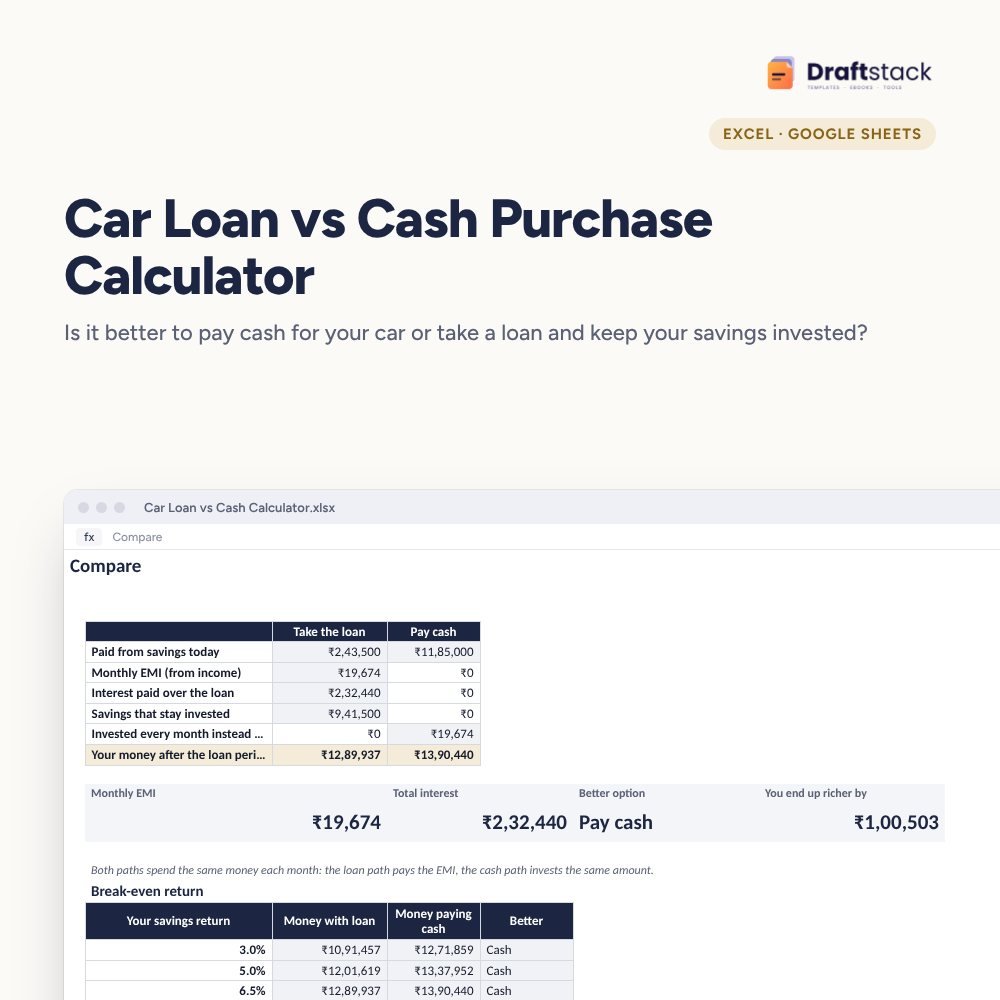 The template from this guideCar Loan vs Cash Purchase Calculator (Excel)
₹99
 WhatsApp
Free Monthly Budget Sheet
A printable one-page budget sheet: income, fixed bills, daily spending and savings for the month. Print it or fill it on your phone.
More guides
Rent vs Buy a House in India: How to Decide with Numbers
The real cost of buying (not just EMI), how to compare it fairly with renting, a worked example for an ₹85 lakh flat, and the questions to ask before you sign.
Income Tax for Freelancers in India: TDS, 44ADA and Advance Tax
How freelancers are taxed, how presumptive taxation works, what TDS means for you, when to pay advance tax, and a worked example for FY 2026-27.
CTC to In-hand Salary: How to Calculate Your Take-home Pay
Every line between CTC and the amount in your bank: employer PF, gratuity, variable pay, employee PF, professional tax and income tax, with a worked FY 2026-27 example.