How to Build a Sales Pipeline That Forecasts Well
A sales pipeline is the list of deals you're working on, organised by how close each one is to closing. Done well, it tells you what revenue is coming and where to spend your time.
Step 1: Define stages with clear exit rules
Each stage should have a test that's either true or false:
- Lead: a company that might need what you sell
- Qualified: they have a need, a budget and a timeline, and you've met the decision-maker
- Proposal sent: a written proposal or quote is with them
- Negotiation: they're discussing price and terms, not whether to buy
- Won / Lost: PO received, or they've said no
If a salesperson can't say which test a deal passed, it doesn't move.
Step 2: Set probabilities from your history
Start with typical numbers (10%, 25%, 50%, 75%) and refine them. If 60% of your proposals turn into orders, use 60% for "Proposal sent". Real history beats generic numbers.
Step 3: Weighted forecast
Weighted value = deal value × stage probability. Add the weighted values of deals expected to close in a month for that month's forecast. A ₹20 lakh deal at proposal (50%) counts as ₹10 lakh.
Step 4: Keep next steps honest
Every open deal needs a next step and a date: "Send revised quote by Thursday". Deals without one are wishes. Flag deals with no contact in 14 days; they're going cold.
Step 5: Clean the pipeline every week
- Move deals that passed their stage test
- Push back close dates that slipped, and note why
- Mark dead deals as Lost; an inflated pipeline is worse than a small one
Metrics that matter
1. Win rate: won ÷ (won + lost)
2. Average deal size and sales cycle length
3. Pipeline coverage: open weighted pipeline ÷ next quarter's target. Many B2B teams aim for 3x unweighted coverage.
4. Lost reasons: price, delivery, competitor, no decision
Run a 30-minute weekly sales meeting
Go through deals closing this month and next, deals going cold, and new leads. Don't review every deal every week.
Our Sales Pipeline & Forecast Tracker gives you stages with your own probabilities, weighted forecast by month, alerts for cold deals and win rates by owner, in a spreadsheet your team can share.
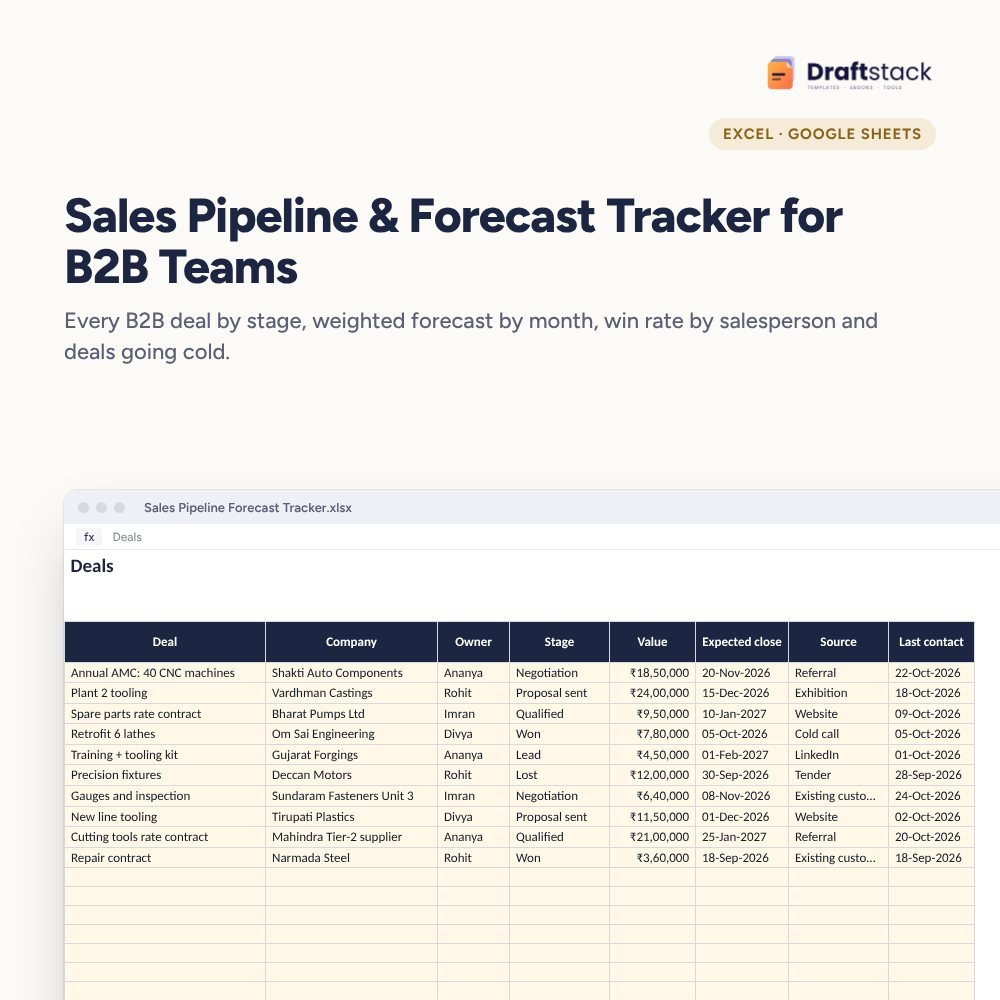 The template from this guideSales Pipeline & Forecast Tracker for B2B Teams (Excel)
₹399
 WhatsApp
Free Monthly Budget Sheet
A printable one-page budget sheet: income, fixed bills, daily spending and savings for the month. Print it or fill it on your phone.
More guides
How to Manage Vendor Contracts and Renewals
What a vendor master should hold, how notice periods and auto-renewals trap companies, MSME payment rules, and a quarterly vendor review routine.
Budget vs Actual Variance: How to Calculate and Explain It
Favourable and adverse variance, month vs year-to-date, how to set thresholds, how to write variance explanations, with a worked example.
How to Make a Monthly MIS Report for Management
What goes into a good MIS report, the 10 numbers every management team should see, KPI targets and status rules, and a simple monthly routine.